




 Scan QR Code
Send My Request
How to Ensure Perfect Delivery of Custom Plastic Parts According to Drawing? An In-Depth Guide from Mold Design to Precision Injection Molding
2026-06-04
Custom plastic parts according to drawing require precise mold design and injection molding control to meet exact specifications. Bost details each step to ensure flawless delivery of custom plastic parts from drawings, minimizing errors and optimizing production quality.
- 1. Drawing Evaluation and DFM: The Prerequisite for custom plastic parts according to drawing Success
- 1. Wall Thickness Optimization
- 2. Rational Setting of Draft Angles
- 3. Early Intervention of Moldflow Analysis
- 2. Material Selection: The Foundation Supporting custom plastic parts according to drawing Performance
- 3. Precision Injection Molding Process: Transforming Drawing Specs into Perfect Realities
- 1. Scientific Injection Molding and Multi-Stage Pressure Control
- 2. Strict Tolerance Control and Comprehensive Quality Inspection
- 4. Why Choose GZ-BOST for Customizing Your custom plastic parts according to drawing?
- 5. Collaboration: How to Efficiently Launch Your Custom Plastic Parts Project
In cross-border B2B manufacturing procurement, overseas supply chain managers and product engineers constantly face a major challenge: how to ensure that a supplier located on the other side of the ocean can thoroughly understand complex engineering drawings and deliver the final products without any deviations?
For high-precision industrial components, medical device enclosures, or automotive plastic parts, any micro-deviation in dimensions can cause the entire assembly line to grind to a halt. This is why, in global sourcing networks, finding a professional manufacturer capable of strictly executing custom plastic parts according to drawing is of paramount importance. This article will provide you with a comprehensive breakdown of how to transform a 2D or 3D technical blueprint into a high-quality physical plastic part, covering upfront mold design, mid-stage injection molding processes, and back-end material science.
1. Drawing Evaluation and DFM: The Prerequisite for custom plastic parts according to drawing Success
From the perspective of the technical team at Bost (GZ-BOST), the very first step upon receiving a drawing is never blindly arranging for mold making in the workshop, but rather conducting a rigorous DFM (Design for Manufacturability) evaluation. More often than not, drawings from overseas clients are designed under ideal conditions without fully accounting for the physical behavior of plastics during the injection process. Failing to perform this upfront review frequently leads to expensive mold modifications and product defects.
1. Wall Thickness Optimization
In plastic injection molding, uneven wall thickness is the primary culprit behind "sink marks" and "warping" in the finished product. When evaluating your custom plastic parts according to drawing project, our engineers check the structural design to ensure that wall thickness transitions as uniformly as possible. If certain areas are too thick, we will suggest coring out the sections and adding ribs to maintain structural strength while shortening the cooling cycle.
2. Rational Setting of Draft Angles
To allow the plastic part to smoothly eject from the mold cavity after molding, the sidewalls perpendicular to the parting line must be designed with a specific taper. For conventional engineering plastics, a draft angle of $1^\circ$ to $2^\circ$ is typically required. If the surface involves specific texturing or graining, the draft angle may need to be increased to $3^\circ$ to $5^\circ$. A lack of proper draft angles will cause scratches on the product surface, making it impossible to perfectly replicate the cosmetic requirements specified in the drawing.
3. Early Intervention of Moldflow Analysis
By utilizing high-end moldflow analysis software, we can simulate the flow, packing, and cooling phases of the plastic melt within the mold cavity before any steel is cut. This allows us to predict weld lines, air traps, and deformation tendencies in advance, enabling us to adjust the location and quantity of gates before manufacturing the mold.
2. Material Selection: The Foundation Supporting custom plastic parts according to drawing Performance
Engineering plastics come in a vast array of grades, each featuring unique shrinkage rates, flow characteristics, and mechanical strengths. When clients request the production of custom plastic parts according to drawing, the drawings usually specify a particular plastic resin or set of performance criteria (such as high-temperature resistance, UV stabilization, or UL94 V0 flame retardancy).
To assist procurement teams in rapidly assessing the performance of different materials in precision injection molding, we have compiled the following comparison table of commonly used engineering plastics:
| Material Abbreviation | Chemical Name | Typical Shrinkage Range (%) | Core Physical/Chemical Advantages | Typical Application Fields |
|---|---|---|---|---|
| ABS | Acrylonitrile Butadiene Styrene | $0.4 - 0.7$ | Excellent impact resistance, rigidity, and dimensional stability; highly suitable for electroplating and painting. | Consumer electronics housings, automotive dashboards, home appliance components. |
| PC | Polycarbonate | $0.5 - 0.7$ | Highly transparent, outstanding impact strength (bulletproof glass material), great thermal resistance. | Medical device lenses, protective face shields, high-end industrial light covers. |
| PA66 (Nylon) | Polyamide 66 | $1.0 - 2.0$ | Exceptional mechanical strength, wear resistance, and self-lubricating properties; rigidity doubles when glass fiber (GF) reinforced. | Industrial gears, structural parts around car engines, heavy-duty fasteners. |
| POM (Acetal) | Polyoxymethylene | $1.5 - 2.5$ | Extremely high rigidity and hardness, superior wear resistance and creep resistance, excellent dimensional recovery. | Precision bearings, valve cores, kinematic mechanical transmission parts. |
| PBT | Polybutylene Terephthalate | $1.5 - 2.0$ | Outstanding electrical insulation, chemical corrosion resistance, and thermal aging resistance. | Electronic connectors, switch housings, automotive electrical components. |
As shown in the table above, shrinkage rates vary significantly between different materials (for instance, the shrinkage rate of ABS is notably lower than that of POM). If the mold cavity dimensions are not accurately calculated based on the specific material designated in the drawing during the mold design stage, the final custom plastic parts according to drawing will inevitably exceed the allowable tolerance range. Bost possesses extensive experience in material modification and application, ensuring a perfect match between mold dimensions and material characteristics.
3. Precision Injection Molding Process: Transforming Drawing Specs into Perfect Realities
Once the mold is fabricated, the true test shifts to the injection molding production floor. How can we fine-tune the parameters of the injection molding process so that tens of thousands of mass-produced parts remain highly consistent with the dimensional tolerances on the drawing?
1. Scientific Injection Molding and Multi-Stage Pressure Control
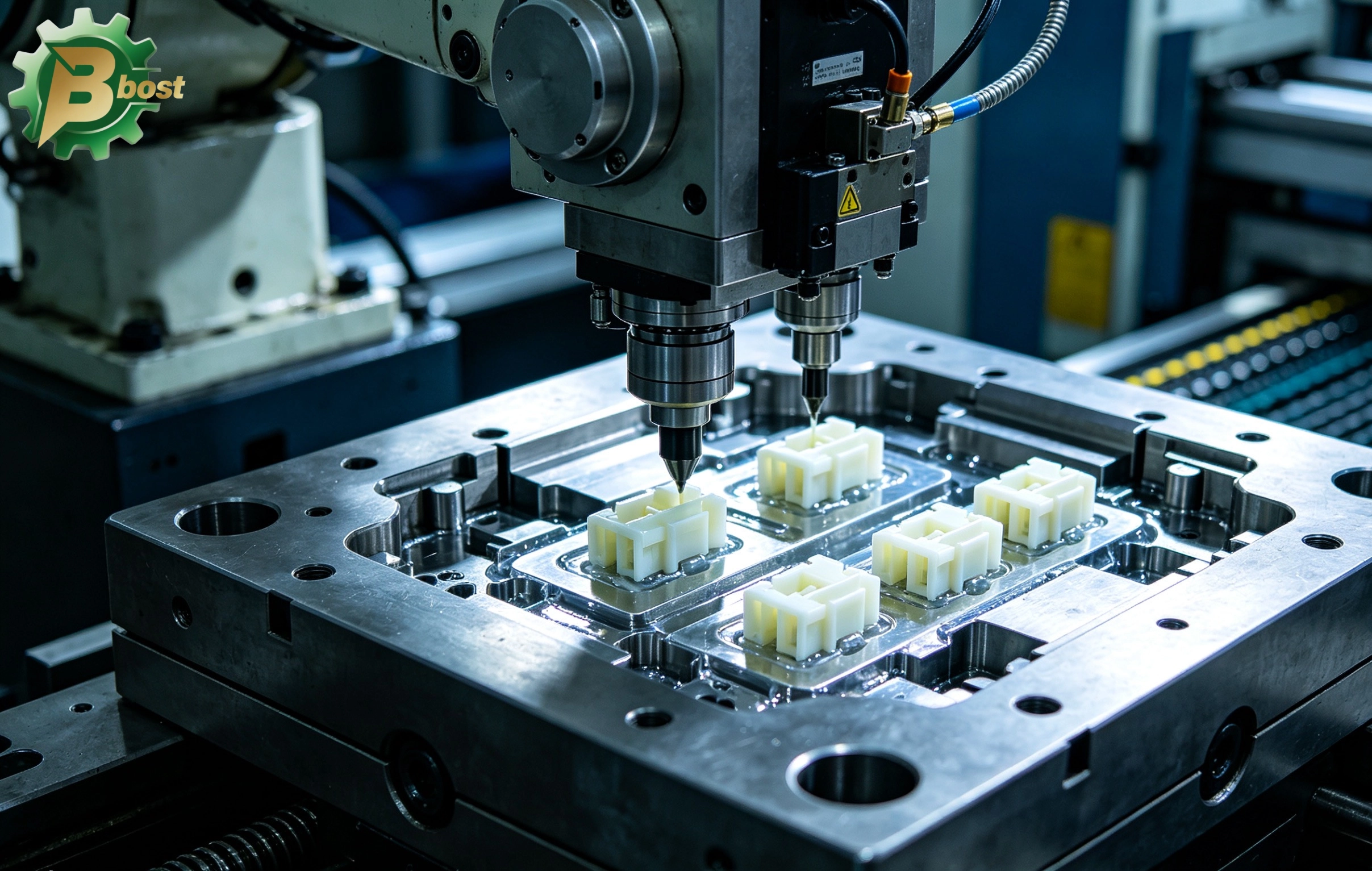
Modern precision injection molding no longer relies on the "gut feeling" of operators, but rather on scientific management driven by real-time sensor data. When producing custom plastic parts according to drawing, we divide the injection process into three distinct stages: filling, packing, and cooling. By accurately controlling the injection speed and multi-stage packing pressure, we ensure that the plastic melt completely fills every micro-feature of the mold cavity while preventing flash or internal stresses caused by over-packing.
2. Strict Tolerance Control and Comprehensive Quality Inspection
For demanding engineering plastic components, our precision injection molding workshop can strictly control dimensional tolerances within a tight range of $\pm 0.02\text{mm}$ to $\pm 0.05\text{mm}$. To verify whether the finished parts truly conform to the drawing requirements, Bost has established an advanced quality control laboratory equipped with:
-
2D Optical Measuring Systems & 3D Coordinate Measuring Machines (CMM): Carrying out comprehensive digital measurements of critical geometric dimensions, coaxiality, and flatness specified in the drawings.
-
Spectrophotometers & Gloss Meters: Ensuring that the surface visual effects meet the criteria defined in the drawing (such as Pantone color codes or VDI 3400 texturing standards).
-
Tensile Testers & High-Low Temperature Alternating Climatic Chambers: Evaluating the mechanical strength and dimensional stability of plastic parts under extreme and harsh working environments.
4. Why Choose GZ-BOST for Customizing Your custom plastic parts according to drawing?
In the highly competitive global digital marketing and manufacturing landscape, Guangzhou Bost (GZ-BOST) has become a long-term, trusted partner for numerous mid-to-high-end buyers worldwide, backed by over ten years of experience in B2B overseas digital marketing and custom manufacturing.
-
Profound Industry Expertise & Seamless Engineering Alignment: Our team of project engineers can read English 2D/3D drawings without any communication barriers (supporting Solidworks, Pro/E, UG, etc.) and deeply understands GD&T (Geometric Dimensioning and Tolerancing) standards. You never have to worry about design misinterpretations caused by cross-border communication gaps.
-
Rigorous International Quality Management System: We fully implement the ISO 9001:2015 management standard. Every step in the production process—from incoming quality control (IQC) of raw materials to in-process quality control (IPQC) and final pre-shipment inspection (FQC)—is fully traceable, ensuring that every batch of delivered custom plastic parts according to drawing is flawless.
-
Flexible Prototyping and Mass Production Capabilities: Whether you need small-batch prototyping (Rapid Prototyping) in the early stages of product development or large-scale mass production of hundreds of thousands of pieces annually, Bost provides the most cost-effective solutions by optimizing mold structures (such as utilizing interchangeable mold bases or multi-cavity designs).
5. Collaboration: How to Efficiently Launch Your Custom Plastic Parts Project
The secret to successful cross-border supply chain management lies in efficient information flow. To ensure that your custom plastic parts according to drawing project passes technical review and enters production as quickly as possible, we recommend providing the following comprehensive information when sending us your inquiry:
-
Multi-Format Engineering Drawings: Provide 2D drawings with complete tolerance annotations (PDF/DWG format) alongside 3D digital models used for mold toolmaking (STEP/STP/IGS format).
-
Clear Material and Post-Processing Requirements: Please specify the required plastic resin brand, color codes (Pantone/RAL), and surface finishes (such as mirror polishing, matte, texturing, or silkscreen printing).
-
Project Lifecycle and Single-Batch Order Volumes: This will directly dictate the selection of mold steel (such as using P20, 718H, or high-durability S136 stainless steel) and the number of mold cavities we design for you.
Direct Engineering Channel: Ready to transform your creative designs into tangible, high-precision plastic products? Visit our official website today at Guangzhou Bost Official Website, or email your design drawings and detailed requirements directly to our official service inbox. Our senior B2B engineering expert team will provide you with a free DFM technical assessment and a highly competitive custom quote within 24 hours, helping your new product rapidly capture market opportunities!
Recommended for you
The Peak Art of Custom Manufacturing According to Drawings: Comprehensive Guide to Precision Solutions for Custom Parts According to Drawing
Ending Mechanical Wear and Resonance: The Comprehensive Guide to Precision Customization and Mass Production of a Custom Rubber Pad
The Ultimate Armor for Smart Hardware: Advanced Customization and Precision Injection Molding Guide for a Custom Plastic Box
The Ultimate Weapon to Tame Vibration and Noise: Deep Dive into the Custom Process and Mass Production Logic of a Custom Rubber Bushing
Product Categories
FAQ
FAQs
What is the minimum order quantity (MOQ)? Do you support small-batch trial production?
The MOQ for standard products is ≥100kg. We support small-batch trial production (as low as 20kg) and provide mold testing reports and performance data feedback.
Can Bost customize modified plastics with special properties?
Yes! We offer modification services such as reinforcement, flame retardancy, conductivity, wear resistance, and UV resistance, for example:
• Adding carbon fiber to enhance stiffness
• Reducing the coefficient of friction through PTFE modification
• Customizing food-grade or medical-grade certified materials
What are the core advantages of Bost engineering plastics compared to ordinary plastics?
Bost engineering plastics feature ultra-high mechanical strength, high-temperature resistance (-50°C to 300°C), chemical corrosion resistance, and wear resistance. Compared to ordinary plastics, their service life is extended by 3 to 8 times, making them suitable for replacing metals in harsh environments.
What is the delivery lead time? Do you offer global logistics?
Standard products: 5–15 working days; custom modifications: 2–4 weeks. We support global air/sea freight and provide export customs clearance documents (including REACH/UL certifications).
How do I select the appropriate engineering plastic grade for my product?
Selection should be based on parameters such as load conditions (e.g., pressure/friction), temperature range, medium contact (e.g., oil/acid), and regulatory requirements (e.g., FDA/RoHS). Our engineers can provide free material selection consulting and sample testing.
You may also like
Custom Plastic Knobs Precision Injection Molded
More Details →
Custom Plastic Knobs Precision Injection Molded
Custom Injection Molded Parts from Drawings
More Details →
Custom Injection Molded Parts from Drawings
Underwater Camera Shell Custom Plastic Molding
More Details →
Underwater Camera Shell Custom Plastic Molding
Leave a Message
Have any questions or concerns about our products? Please leave us a message here, and our team will get back to you promptly.

24 hours quotes delivered
Submit CAD files, get quote in 24 hours

No MOQ required
From prototyping to high-volume

±0.02 mm Precision
Advanced CNC with full inspections

1,000+ tons in stock
26 materials ready to ship
© 2026 BOST. All Rights Reserved.