




 Scan QR Code
Send My Request
How to Ensure Perfect Delivery of Custom Rubber Parts According to Drawing? A Comprehensive Guide from Mold Design to Precision Injection Molding
2026-06-04
Custom rubber parts according to drawing require precise mold design and injection molding to meet exact specifications. Bost details the critical steps for flawless custom rubber parts made to drawing, ensuring quality and accuracy in custom rubber molding from drawing processes.
- 1. Drawing Evaluation and DFM: The Golden First Step to Avoid Manufacturing Defects
- 1. Tolerance Control and Material Shrinkage Rate
- 2. Parting Line and Draft Angle
- 2. Material Science: Precise Matching Based on Application Scenarios
- 3. Technical Capabilities Behind High-Ranking Production: The Injection Molding Process
- 1. Precise Closed-Loop Control of Temperature and Pressure
- 2. Early Intervention of Moldflow Analysis
- 4. Why Choose GZ-BOST as Your Customization Partner?
- 5. Kickstart Your Next Custom Project: How to Get a Quote Efficiently
In modern industrial manufacturing, whether it is an automotive sealing system, a medical device component, or a protective enclosure for high-end electronics, non-standard custom rubber and plastic parts carry critical functionalities. For overseas procurement managers and engineers, finding a supplier who can thoroughly understand engineering drawings, grasp strict tolerance requirements, and achieve high-yield mass production is often a long and uncertain gamble.
In actual cross-border procurement, the core demand of buyers is highly straightforward: how to ensure that the final delivered product matches the engineering drawings 100%? This is why, when searching for global partners, industry experts always emphasize the end-to-end quality control of creating custom rubber parts according to drawing. This article will provide an in-depth analysis of how to transform a 2D/3D blueprint into a flawless industrial reality from the professional dimensions of mold design, injection molding processes, and material selection.
1. Drawing Evaluation and DFM: The Golden First Step to Avoid Manufacturing Defects
When a drawing with complex geometry and strict tolerance requirements is submitted to a factory, an excellent manufacturing enterprise will never blindly jump straight into mold making. True professional service begins with a DFM (Design for Manufacturability) evaluation.
Rubber and plastics undergo physical shrinkage and deformation during high-temperature injection molding or vulcanization. If the drawing design fails to fully consider material characteristics, it can easily lead to defects such as shrinkage, air pockets, fractures, or excessive flash on the production line.
1. Tolerance Control and Material Shrinkage Rate
Different rubber materials (such as EPDM, FKM, Silicone) and engineering plastics (such as TPU, TPE) have vastly different coefficients of thermal expansion and contraction. Experienced mold designers will precisely reserve shrinkage rates in the mold cavity dimensions during the drawing review phase based on the specific material grade. For highly demanding precision injection molding projects, tolerances may even need to be controlled within $\pm 0.02\text{mm}$.
2. Parting Line and Draft Angle
The rational selection of the parting line not only affects the product's appearance but also determines the sealing performance of custom rubber parts according to drawing. If the parting line is improperly designed, flash (overflow) will occur on critical sealing surfaces, causing component failure. Meanwhile, an appropriate draft angle ensures that the product will not be scratched or deformed during demolding.
2. Material Science: Precise Matching Based on Application Scenarios
When customizing industrial parts, there is no absolute "best" material, only the "most suitable" physical properties. When ordering custom rubber parts according to drawing, overseas buyers frequently need to balance temperature resistance, chemical resistance, hardness, and cost.
To help your supply chain team make rapid decisions, we have summarized the core characteristics and typical application scenarios of common custom rubber and elastomer materials below:
| Material Abbreviation | Full Chemical Name | Shore A Hardness Range | Core Advantages | Typical Application Scenarios |
|---|---|---|---|---|
| NBR | Nitrile Butadiene Rubber | $40 - 90$ | Excellent oil resistance, wear resistance, highly cost-effective | Automotive fuel system seals, industrial machinery oil seals |
| EPDM | Ethylene Propylene Diene Monomer | $40 - 90$ | Outstanding weather resistance, ozone resistance, anti-aging, and water vapor resistance | Outdoor architectural seals, automotive window weatherstripping, home appliance parts |
| Silicone | Silicone Rubber | $10 - 80$ | Extremely wide temperature range ($-60^\circ\text{C}$ to $230^\circ\text{C}$), great biocompatibility, non-toxic | Medical device components, food-grade container seals, electronic buttons |
| Viton (FKM) | Fluorocarbon Elastomer | $60 - 90$ | Superior high-temperature resistance (over $250^\circ\text{C}$), resistant to strong acids, alkalis, and chemical solvents | Aerospace seals, chemical engineering pipeline and valve seals |
| TPU/TPE | Thermoplastic Polyurethane / Elastomer | $60\text{A} - 70\text{D}$ | Combines the processing efficiency of plastics with the elasticity of rubber; recyclable and ideal for precision injection molding | Protective cases for electronics, sports equipment grips, wear-resistant rollers |
As shown in the comparison table above, if your project involves high-frequency consumer electronics or medical devices, the precision injection molding process paired with high-molecular silicone or TPU is the preferred choice. However, for harsh industrial or automotive environments, you must select NBR or FKM strictly based on the medium environment specified in the engineering drawing.
3. Technical Capabilities Behind High-Ranking Production: The Injection Molding Process
High-quality delivery relies on absolute control over every single variable on the production floor. No matter how perfect the numbers on a drawing look, they must ultimately be executed via the parameters of the injection molding machine.
1. Precise Closed-Loop Control of Temperature and Pressure
When manufacturing custom rubber parts according to drawing, slight fluctuations in vulcanization temperature (for rubber) or melt temperature (for thermoplastic elastomers) can lead to uneven hardness or over-curing (aging). Modern precision injection molding workshops generally utilize microcomputer control systems to monitor injection pressure, holding pressure, and mold temperature in real-time, ensuring uniform quality for every single shot.
2. Early Intervention of Moldflow Analysis
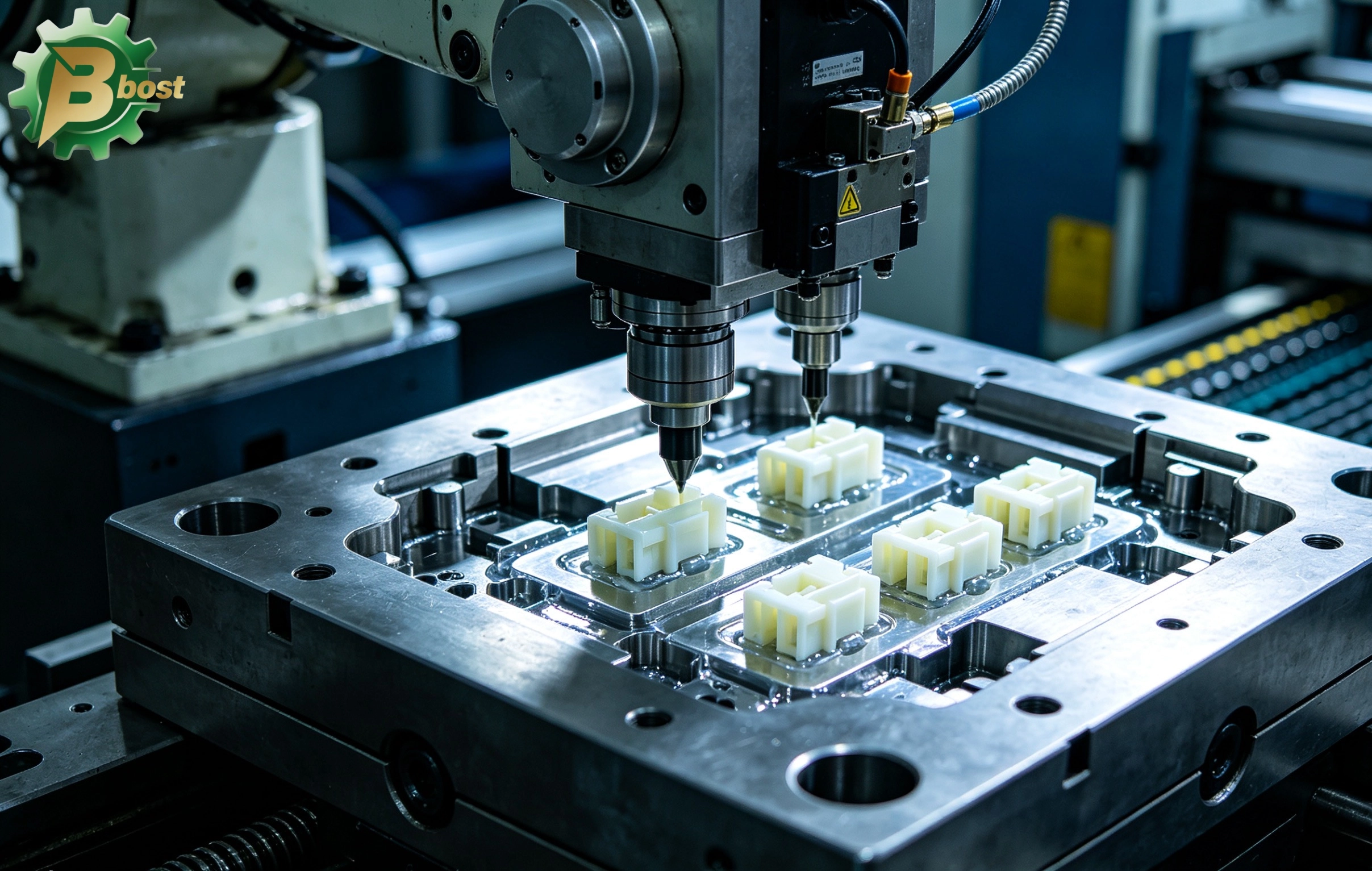
Before investing capital into manufacturing expensive molds, utilizing software for moldflow analysis has become an industry standard. By simulating the flow trajectory, velocity, and pressure distribution of plastic or rubber within the mold cavity, weld lines, air traps, and poor venting locations can be predicted in advance. This digital approach saves clients substantial mold modification time and prototyping costs.
4. Why Choose GZ-BOST as Your Customization Partner?
When looking for a supply chain partner capable of flawlessly executing custom rubber parts according to drawing, Guangzhou Bost (GZ-BOST) has become the preferred supplier for many global Fortune 500 companies and small-to-medium innovative enterprises, thanks to our profound industry expertise.
-
Over a Decade of B2B Manufacturing Experience: We deeply understand international buyers' strict compliance requirements for quality standards (such as ISO 9001 and IATF 16949). Whether communicating complex engineering language or complying with environmental certifications like RoHS and REACH, we coordinate seamlessly.
-
One-Stop Engineering and Manufacturing Services: From the moment we receive your 2D/3D drawings, our engineering team is involved throughout the entire process—from initial DFM reviews and high-precision mold design to final mass production via precision injection molding. We are not just a contract manufacturer; we are your technical think tank.
-
Advanced Hardware and Rigorous Quality Control: Bost has invested heavily in importing high-precision injection molding machinery, alongside 2D and 3D precision measuring instruments. We conduct full dimensional inspections, tensile tests, hardness checks, and various other physical property tests on every batch of custom rubber components to ensure every item leaving the factory is defect-free.
5. Kickstart Your Next Custom Project: How to Get a Quote Efficiently
Time efficiency in cross-border procurement is incredibly valuable. To fast-track your custom rubber parts according to drawing project, we recommend preparing the following information when sending us an inquiry:
-
Complete Engineering Drawings: Supported formats include 2D (PDF, DWG) and 3D (STEP, STP, IGS). Please clearly mark critical dimensional tolerances in the drawings.
-
Clear Material and Hardness Requirements: If undecided, feel free to inform us about the product's specific operating environment (working temperature, contact media, mechanical stress, etc.), and our material experts will provide tailored recommendations.
-
Estimated Order Volume: Whether it is early-stage prototyping or annual mass production (MP), the quantity directly determines the mold cavity layout and overall pricing structure.
Direct Engineering Channel: Are you looking to transform your engineering designs into high-precision physical components? Visit our official website today at Guangzhou Bost Official Website, or email your design drawings and requirements directly to our corporate inbox. Our senior engineering experts will provide you with a free DFM assessment and a highly competitive custom quote within 24 hours.
Recommended for you
The Peak Art of Custom Manufacturing According to Drawings: Comprehensive Guide to Precision Solutions for Custom Parts According to Drawing
Ending Mechanical Wear and Resonance: The Comprehensive Guide to Precision Customization and Mass Production of a Custom Rubber Pad
The Ultimate Armor for Smart Hardware: Advanced Customization and Precision Injection Molding Guide for a Custom Plastic Box
The Ultimate Weapon to Tame Vibration and Noise: Deep Dive into the Custom Process and Mass Production Logic of a Custom Rubber Bushing
Product Categories
FAQ
FAQs
What are the core advantages of Bost engineering plastics compared to ordinary plastics?
Bost engineering plastics feature ultra-high mechanical strength, high-temperature resistance (-50°C to 300°C), chemical corrosion resistance, and wear resistance. Compared to ordinary plastics, their service life is extended by 3 to 8 times, making them suitable for replacing metals in harsh environments.
What is the minimum order quantity (MOQ)? Do you support small-batch trial production?
The MOQ for standard products is ≥100kg. We support small-batch trial production (as low as 20kg) and provide mold testing reports and performance data feedback.
Can Bost customize modified plastics with special properties?
Yes! We offer modification services such as reinforcement, flame retardancy, conductivity, wear resistance, and UV resistance, for example:
• Adding carbon fiber to enhance stiffness
• Reducing the coefficient of friction through PTFE modification
• Customizing food-grade or medical-grade certified materials
How do I select the appropriate engineering plastic grade for my product?
Selection should be based on parameters such as load conditions (e.g., pressure/friction), temperature range, medium contact (e.g., oil/acid), and regulatory requirements (e.g., FDA/RoHS). Our engineers can provide free material selection consulting and sample testing.
What is the delivery lead time? Do you offer global logistics?
Standard products: 5–15 working days; custom modifications: 2–4 weeks. We support global air/sea freight and provide export customs clearance documents (including REACH/UL certifications).
You may also like
Custom Plastic Knobs Precision Injection Molded
More Details →
Custom Plastic Knobs Precision Injection Molded
Custom Injection Molded Parts from Drawings
More Details →
Custom Injection Molded Parts from Drawings
Underwater Camera Shell Custom Plastic Molding
More Details →
Underwater Camera Shell Custom Plastic Molding
Leave a Message
Have any questions or concerns about our products? Please leave us a message here, and our team will get back to you promptly.

24 hours quotes delivered
Submit CAD files, get quote in 24 hours

No MOQ required
From prototyping to high-volume

±0.02 mm Precision
Advanced CNC with full inspections

1,000+ tons in stock
26 materials ready to ship
© 2026 BOST. All Rights Reserved.