




 Scan QR Code
Send My Request
In-Depth Analysis: The Core Injection Molding Process and Mold Design Guide for High-Precision Custom Plastic Connectors
2026-05-21
Custom plastic connector manufacturing demands precision; this guide from Bost details core injection molding techniques and mold design essentials for high-precision custom plastic connectors for electronics. Learn how to optimize processes and design molds that meet exacting industry standards.
- Why High-End Manufacturing Relies on Custom Plastic Connectors?
- Precision Injection Molding Process: The Core Element Dictating Connector Lifespan
- 1. Mold Design with Nearly Zero Margin for Error
- 2. Strict Control of High Temperature and Cooling Parameters
- The Material Selection Matrix for Engineering Plastics
- Common Customer Pain Points and Breakthrough Solutions in Manufacturing Custom Plastic Connectors
- Pain Point 1: Dimensional Shrinkage and Warpage Deformation
- Pain Point 2: Weather Resistance and Anti-Aging in Harsh Environments
- Choose BOST: Your Reliable Partner in Precision Injection Molding
In modern industry, automotive electronics, and medical devices, connectors play the critical role of a "neural hub." While standardized products can meet some basic needs, when faced with complex installation spaces, harsh operating environments, or specific electrical requirements, a custom plastic connector becomes the only breakthrough solution for engineers.
However, developing a custom connector from a conceptual drawing to final mass production is no easy feat. It not only tests the microscopic precision of mold design but also places almost stringent demands on the stability of the injection molding process. Today, drawing on over ten years of industry experience, we will deeply analyze how to create a high-quality custom plastic connector that truly addresses customer pain points through outstanding precision injection molding technology.
Why High-End Manufacturing Relies on Custom Plastic Connectors?
Although off-the-shelf public mold connectors are low in cost, they often expose fatal flaws in many real-world production scenarios. For instance, the powertrain systems of new energy vehicles need to operate in continuous high-temperature and high-vibration environments, where conventional connectors are highly prone to loose latches or brittle shells. Another example is precision medical equipment, where the internal space is extremely confined, imposing dual standards for insulation and biocompatibility.
In these scenarios, the core value of a custom plastic connector becomes prominent:
-
Ultimate Space Utilization: Irregular designs tailored to the internal structure of the end product perfectly avoid interference areas.
-
Exclusive Performance: Directional selection or even modification of engineering plastics based on specific application scenarios (e.g., anti-UV, V0 flame retardant, acid and alkali resistance).
-
Brand Differentiation and Anti-Counterfeiting: Unique structural designs not only improve assembly efficiency but also form technical barriers, preventing competitors from easily substituting them.
Precision Injection Molding Process: The Core Element Dictating Connector Lifespan
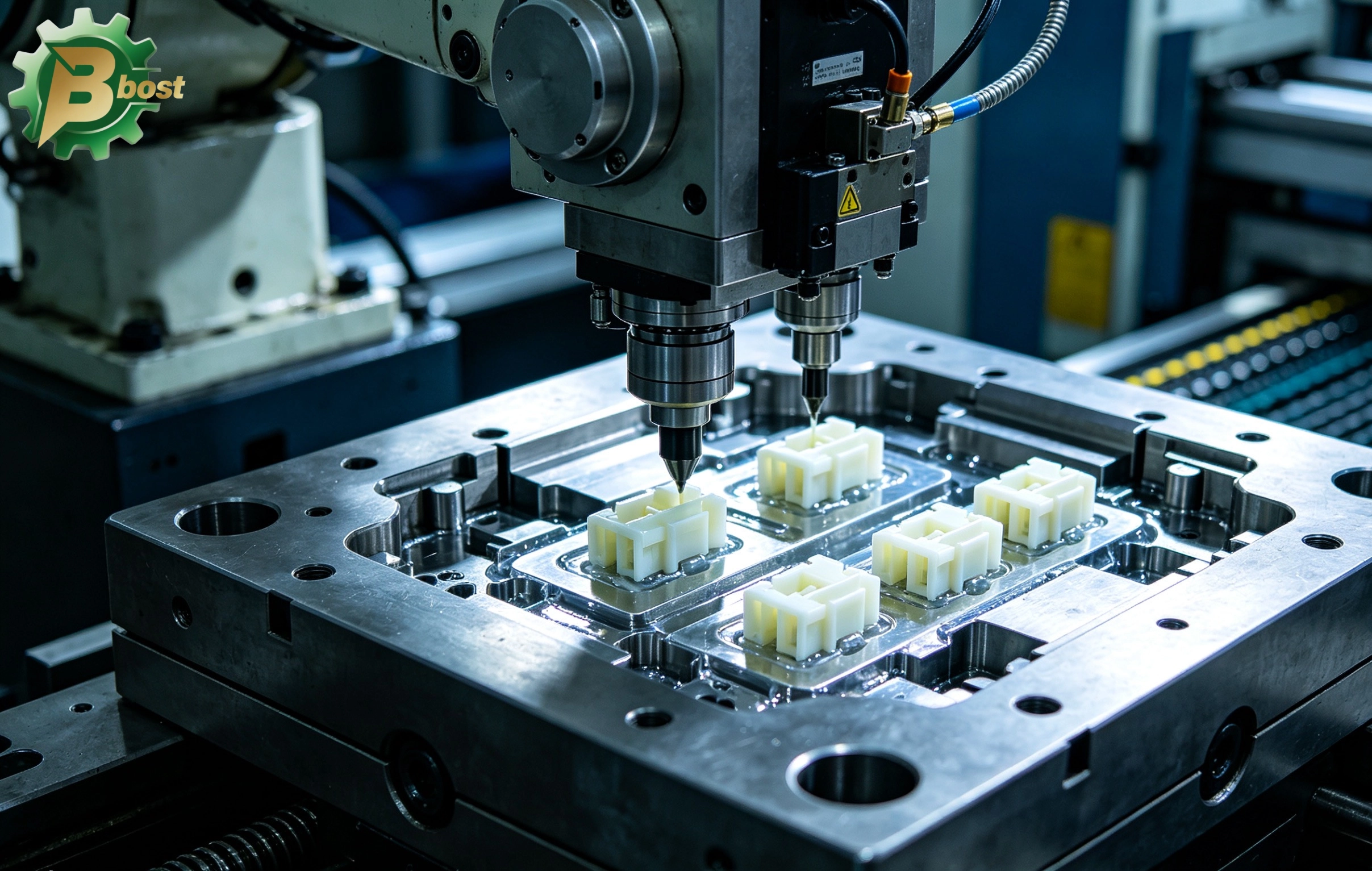
To perfectly materialize the drawings of a custom plastic connector, the "injection molding process" is the lifeline determining success or failure. Connectors often feature thin walls, numerous holes, and complex latches; any minor process fluctuation can lead to fatal dimensional deviations.
1. Mold Design with Nearly Zero Margin for Error
For a custom plastic connector, mold design is the source. We often encounter clients coming to us for help with failed mold drawings, and the most common issues are insufficient draft angles and uneven wall thickness. In our mold design workflow, engineers must conduct rigorous Moldflow analysis. By simulating the flow, cooling, and shrinkage of the plastic melt in the mold cavity, we can predict potential weld lines and air trap issues in advance. Especially for the dense pinholes in connectors, the machining precision of mold inserts must be controlled within 0.005mm to ensure the smooth insertion and extraction of subsequent metal terminals.
2. Strict Control of High Temperature and Cooling Parameters
Precision injection molding is not just simply melting and cooling material. Take the commonly used LCP (Liquid Crystal Polymer) as an example. This material has excellent fluidity, making it perfect for fine-pitch custom plastic connectors. However, if the injection speed and holding pressure of the injection molding machine are not properly matched, flashes (burrs) can easily occur. Once flashes appear inside the connector, it not only causes assembly failure but may even trigger a short circuit. Therefore, high-speed precision injection molding machines with fully closed-loop control are a rigid necessity for producing such high-end components.
The Material Selection Matrix for Engineering Plastics
Choosing the right material is the cornerstone of a successful custom plastic connector. Different plastic pellets have a world of difference in shrinkage rates, mechanical strength, and electrical properties. To make it clear at a glance, we have compiled a comparison of commonly used connector materials in the injection molding industry:
Common Customer Pain Points and Breakthrough Solutions in Manufacturing Custom Plastic Connectors
Throughout our years of B2B customer service, we have found that when engineers source and customize a custom plastic connector, their biggest headaches are often the following two issues:
Pain Point 1: Dimensional Shrinkage and Warpage Deformation
Real Scenario: A communications equipment client once complained that the shells produced by their previous supplier shrank after sitting for a month, making it impossible to snap the internal PCB board into place. Our Solution: This phenomenon often occurs with crystalline plastics. During the injection molding process, besides strictly controlling holding time and mold temperature, we target the elongated or thin-walled structures of the custom plastic connector by reserving a reasonable anti-deformation allowance (fidelity margin) in the early stages of mold design. We also utilize Conformal Cooling technology to ensure consistent cooling rates across all parts of the product, physically locking down the dimensions.
Pain Point 2: Weather Resistance and Anti-Aging in Harsh Environments
Real Scenario: Outdoor solar photovoltaic connectors must withstand extreme cold and heat temperature differences, as well as intense ultraviolet radiation. Our Solution: Conventional modified plastics are hard to sustain over time. We recommend clients use special PC or PPO materials enhanced with anti-UV agents and glass fiber (GF). Concurrently, utilizing the Two-Shot Molding process, we mold the hard plastic shell and soft silicone sealing ring in one go. This not only eliminates the labor cost of secondary assembly but also endows the custom plastic connector with perfect IP68 waterproof and dustproof capabilities.
Choose BOST: Your Reliable Partner in Precision Injection Molding
Creating a flawless custom plastic connector is never a crude process of simply "handing over a drawing, opening a mold, and shooting a product." Rather, it is a deep synergy from materials science to manufacturing processes. As a professional manufacturer deeply rooted in the injection molding plastic field, Guangzhou BOST Plastic (BOST) is always committed to transforming clients' engineering concepts into highly competitive physical products.
We not only have an experienced mold design team but are also equipped with world-class precision injection molding equipment. From early Design for Manufacturability (DFM) evaluations, to core injection molding process optimization, to rigorous quality inspection, BOST provides an end-to-end, one-stop solution for your custom plastic connector projects.
Ready to turn your connector designs into reality? Don't let inferior molds and rough injection molding processes delay your product's time-to-market. Visit our official website now at https://www.gz-bost.com to learn more about our custom injection molding solutions. You can directly submit your 3D drawings, and our engineering team will provide you with a professional manufacturability analysis and a detailed quotation within 24 hours!
Recommended for you
The Peak Art of Custom Manufacturing According to Drawings: Comprehensive Guide to Precision Solutions for Custom Parts According to Drawing
Ending Mechanical Wear and Resonance: The Comprehensive Guide to Precision Customization and Mass Production of a Custom Rubber Pad
The Ultimate Armor for Smart Hardware: Advanced Customization and Precision Injection Molding Guide for a Custom Plastic Box
The Ultimate Weapon to Tame Vibration and Noise: Deep Dive into the Custom Process and Mass Production Logic of a Custom Rubber Bushing
Product Categories
FAQ
FAQs
What are the core advantages of Bost engineering plastics compared to ordinary plastics?
Bost engineering plastics feature ultra-high mechanical strength, high-temperature resistance (-50°C to 300°C), chemical corrosion resistance, and wear resistance. Compared to ordinary plastics, their service life is extended by 3 to 8 times, making them suitable for replacing metals in harsh environments.
Can Bost customize modified plastics with special properties?
Yes! We offer modification services such as reinforcement, flame retardancy, conductivity, wear resistance, and UV resistance, for example:
• Adding carbon fiber to enhance stiffness
• Reducing the coefficient of friction through PTFE modification
• Customizing food-grade or medical-grade certified materials
What is the minimum order quantity (MOQ)? Do you support small-batch trial production?
The MOQ for standard products is ≥100kg. We support small-batch trial production (as low as 20kg) and provide mold testing reports and performance data feedback.
How do I select the appropriate engineering plastic grade for my product?
Selection should be based on parameters such as load conditions (e.g., pressure/friction), temperature range, medium contact (e.g., oil/acid), and regulatory requirements (e.g., FDA/RoHS). Our engineers can provide free material selection consulting and sample testing.
What is the delivery lead time? Do you offer global logistics?
Standard products: 5–15 working days; custom modifications: 2–4 weeks. We support global air/sea freight and provide export customs clearance documents (including REACH/UL certifications).
You may also like
Custom Plastic Knobs Precision Injection Molded
More Details →
Custom Plastic Knobs Precision Injection Molded
Custom Injection Molded Parts from Drawings
More Details →
Custom Injection Molded Parts from Drawings
Underwater Camera Shell Custom Plastic Molding
More Details →
Underwater Camera Shell Custom Plastic Molding
Leave a Message
Have any questions or concerns about our products? Please leave us a message here, and our team will get back to you promptly.

24 hours quotes delivered
Submit CAD files, get quote in 24 hours

No MOQ required
From prototyping to high-volume

±0.02 mm Precision
Advanced CNC with full inspections

1,000+ tons in stock
26 materials ready to ship
© 2026 BOST. All Rights Reserved.