




 Scan QR Code
Send My Request
In-Depth Analysis: Why High-Performance Engineering Plastic is the Inevitable Choice to Replace Metal Parts?
2026-04-14
Discover why high-performance engineering plastic is the inevitable choice to replace metal parts. Bost, leading engineering plastic suppliers, offers innovative solutions that enhance durability, reduce weight, and improve efficiency for diverse industries. Choose Bost for advanced engineering plastic materials.
- 1. What is Engineering Plastic? Where lies its Core Advantage?
- 2. Performance Comparison Table of Common Engineering Plastic
- 3. Precision Injection Molding: The Key to Unlocking Engineering Plastic Potential
- 3.1 The Rigor of Mold Design
- 3.2 Drying Treatment and Moisture Control
- 4. Solving Client Pain Points: A Seamless Transition from Metal to Plastic
- 5. Conclusion: Finding Your Most Reliable Engineering Plastic Partner
In today's precision manufacturing landscape, a revolution in materials is quietly taking place. In the past, when discussing high strength, high-temperature resistance, or high-precision components, metal was almost the only answer. However, with the rapid advancement of material science, high-performance Engineering Plastic is shining in critical fields such as aerospace, medical devices, and automotive electronics.
As a manufacturer deeply rooted in the injection molding industry for years, GZ-BOST has observed an increasing trend: more and more clients are shifting from traditional aluminum alloys or stainless steel to customized Engineering Plastic solutions. This is not just for cost reduction, but also for achieving an ultimate leap in performance.
1. What is Engineering Plastic? Where lies its Core Advantage?
Engineering Plastic refers to a group of synthetic polymer materials characterized by superior mechanical properties, thermal stability, and chemical resistance. Unlike standard plastics, they can maintain dimensional stability under extreme and harsh environments.
For B2B purchasers, the reasons for choosing Engineering Plastic are usually based on three key points:
-
Lightweight Advantage: The density is typically half that of aluminum or even lower, which is crucial for energy efficiency and emission reduction in aerospace and transportation.
-
Corrosion Resistance: They resist acid and alkali erosion without expensive surface treatments, extending the lifespan of parts in chemical environments.
-
Design Freedom: Complex injection molding processes can achieve geometric structures that are difficult for metal machining, reducing component counts and assembly costs.
2. Performance Comparison Table of Common Engineering Plastic
To help engineers make more accurate choices during the design phase, we have analyzed and compared several commonly used high-performance Engineering Plastic materials:
3. Precision Injection Molding: The Key to Unlocking Engineering Plastic Potential
Having the right material is only the first step. To ensure that Engineering Plastic delivers performance comparable to metal, refined management of the injection molding process is essential.
3.1 The Rigor of Mold Design
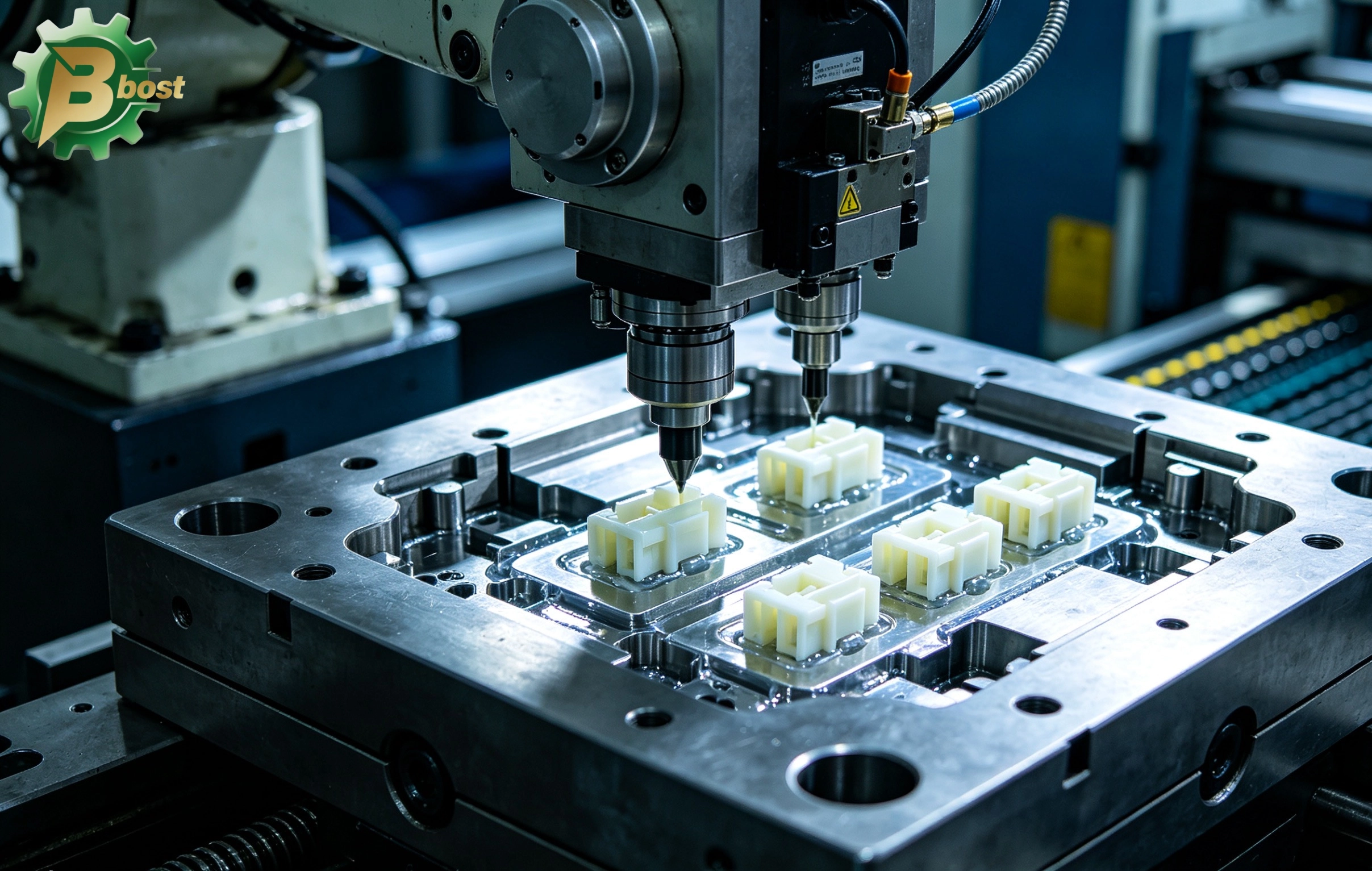
In the workshops of GZ-BOST, when we process high-performance materials like PEEK or PPS, we have a near-obsessive requirement for mold heating balance. Since the melting points of Engineering Plastic are usually very high, even a slight deviation in the mold cooling system can lead to internal stress, causing warpage. We utilize multi-stage temperature control systems to ensure minimal mold temperature fluctuation, which is the foundation of precision injection molding.
3.2 Drying Treatment and Moisture Control
Many clients overlook this: high-performance Engineering Plastic is extremely sensitive to moisture. Even a moisture content exceeding 0.02% can lead to molecular chain degradation during the injection process, reducing the impact resistance of the parts. At GZ-BOST, we implement rigorous pre-treatment using high-standard dehumidifying dryers for 4-6 hours before production.
4. Solving Client Pain Points: A Seamless Transition from Metal to Plastic
In a real-world case at GZ-BOST, a medical device client was using stainless steel for sterilization trays, facing issues with heavy weight, high cost, and rust after repeated autoclaving.
Through our technical intervention, we recommended PPS—a high-performance Engineering Plastic.
-
Challenge: The tray had a complex structure and uneven wall thickness, making it prone to sink marks.
-
Solution: We optimized the mold design and adopted Scientific Molding technology to precisely control the pressure holding curve.
-
Result: The final product weight was reduced by 60%, costs were cut by 45%, and it became fully resistant to repeated steam sterilization at 134°C.
This deep involvement in the entire process—from material selection to precision injection molding—is exactly where GZ-BOST’s core competitiveness lies.
5. Conclusion: Finding Your Most Reliable Engineering Plastic Partner
In this era of efficiency and innovation, Engineering Plastic is no longer just a "metal substitute"; it is becoming the cornerstone of industrial progress. However, mastering these high-performance materials requires profound technical expertise and a rigorous manufacturing system.
Ready to optimize your product design? If you are looking for a one-stop injection molding supplier capable of providing everything from material advice and mold design to high-quality production, GZ-BOST is your ideal choice.
Visit our official website at https://www.gz-bost.com to learn more about our technical details in handling Engineering Plastic, or contact our engineers directly for a professional injection molding solution quote.
Recommended for you
The Peak Art of Custom Manufacturing According to Drawings: Comprehensive Guide to Precision Solutions for Custom Parts According to Drawing
Ending Mechanical Wear and Resonance: The Comprehensive Guide to Precision Customization and Mass Production of a Custom Rubber Pad
The Ultimate Armor for Smart Hardware: Advanced Customization and Precision Injection Molding Guide for a Custom Plastic Box
The Ultimate Weapon to Tame Vibration and Noise: Deep Dive into the Custom Process and Mass Production Logic of a Custom Rubber Bushing
Product Categories
FAQ
FAQs
How do I select the appropriate engineering plastic grade for my product?
Selection should be based on parameters such as load conditions (e.g., pressure/friction), temperature range, medium contact (e.g., oil/acid), and regulatory requirements (e.g., FDA/RoHS). Our engineers can provide free material selection consulting and sample testing.
What are the core advantages of Bost engineering plastics compared to ordinary plastics?
Bost engineering plastics feature ultra-high mechanical strength, high-temperature resistance (-50°C to 300°C), chemical corrosion resistance, and wear resistance. Compared to ordinary plastics, their service life is extended by 3 to 8 times, making them suitable for replacing metals in harsh environments.
Can Bost customize modified plastics with special properties?
Yes! We offer modification services such as reinforcement, flame retardancy, conductivity, wear resistance, and UV resistance, for example:
• Adding carbon fiber to enhance stiffness
• Reducing the coefficient of friction through PTFE modification
• Customizing food-grade or medical-grade certified materials
What is the delivery lead time? Do you offer global logistics?
Standard products: 5–15 working days; custom modifications: 2–4 weeks. We support global air/sea freight and provide export customs clearance documents (including REACH/UL certifications).
What is the minimum order quantity (MOQ)? Do you support small-batch trial production?
The MOQ for standard products is ≥100kg. We support small-batch trial production (as low as 20kg) and provide mold testing reports and performance data feedback.
You may also like
Custom Plastic Knobs Precision Injection Molded
More Details →
Custom Plastic Knobs Precision Injection Molded
Custom Injection Molded Parts from Drawings
More Details →
Custom Injection Molded Parts from Drawings
Underwater Camera Shell Custom Plastic Molding
More Details →
Underwater Camera Shell Custom Plastic Molding
Leave a Message
Have any questions or concerns about our products? Please leave us a message here, and our team will get back to you promptly.

24 hours quotes delivered
Submit CAD files, get quote in 24 hours

No MOQ required
From prototyping to high-volume

±0.02 mm Precision
Advanced CNC with full inspections

1,000+ tons in stock
26 materials ready to ship
© 2026 BOST. All Rights Reserved.