




 Scan QR Code
Send My Request
Special Engineering Plastics Injection Molding Guide: How to Choose High-Performance Materials for Demanding Applications?
2026-04-14
Discover Bost’s expert guide on Special Engineering Plastics Injection Molding. Learn how to choose high-performance materials for demanding applications. Trust leading special engineering plastics suppliers for quality and bulk purchase solutions. Optimize your projects with Bost today.
- 1. What are Special Engineering Plastics?
- 2. Core Material Comparative Analysis Table
- 3. Critical Challenges in Special Engineering Plastics Injection Molding
- Precise Mold Temperature Control
- Wear Resistance of Screws and Barrels
- Precision Injection and Venting Design
- 4. Why Choose GZ-BOST for Your Special Plastic Projects?
- 5. Conclusion: From Material Science to Engineering Practice
In the precision landscape of modern industrial manufacturing, traditional general-purpose plastics and standard engineering plastics are increasingly failing to meet the rigorous demands of cutting-edge fields such as aerospace, medical devices, and semiconductor manufacturing. When ambient temperatures exceed 150°C or chemical environments become extremely complex, Special Engineering Plastics emerge as the irreplaceable frontrunners.
As a professional manufacturer deeply rooted in the injection molding industry for over a decade, GZ-BOST frequently receives inquiries from clients: Why does the molding difficulty multiply when switching to special plastics using the same mold? How can we balance material costs and performance while ensuring part precision? Today, we will deeply analyze the technical logic of this niche sector.
1. What are Special Engineering Plastics?
Special Engineering Plastics typically refer to polymer materials that can withstand long-term service temperatures above 150°C and possess exceptional physical and chemical properties. They sit at the top of the "plastic pyramid," including well-known materials like PEEK (Polyetheretherketone), PPS (Polyphenylene Sulfide), PEI (Polyetherimide), and PAI (Polyamide-imide).
Compared to conventional materials, their advantages are reflected in:
-
Superior Thermal Stability: Retaining high mechanical strength even at elevated temperatures.
-
Excellent Chemical Inertness: Resistance to strong acids, alkalis, and various organic solvents.
-
Outstanding Wear Resistance and Self-lubrication: Reducing wear on mechanical parts during high-speed operation.
2. Core Material Comparative Analysis Table
To give you an intuitive understanding of the performance differences between various Special Engineering Plastics, we have compiled the following table:
| Material Name | Continuous Service Temp (°C) | Core Characteristics | Typical Applications |
| PEEK | 250 - 260 | High strength, fatigue resistance, biocompatibility | Aerospace parts, spinal implants, wafer carriers |
| PPS | 200 - 220 | Excellent flame retardancy, dimensional stability, chemical resistance | Automotive engine components, pump impellers |
| PEI | 170 - 180 | High dielectric strength, transparency, hydrolysis resistance | Medical trays, electronic connectors |
| LCP | 200 - 240 | Extreme flowability, suitable for ultra-thin wall parts | 5G base station components, precision connectors |
3. Critical Challenges in Special Engineering Plastics Injection Molding
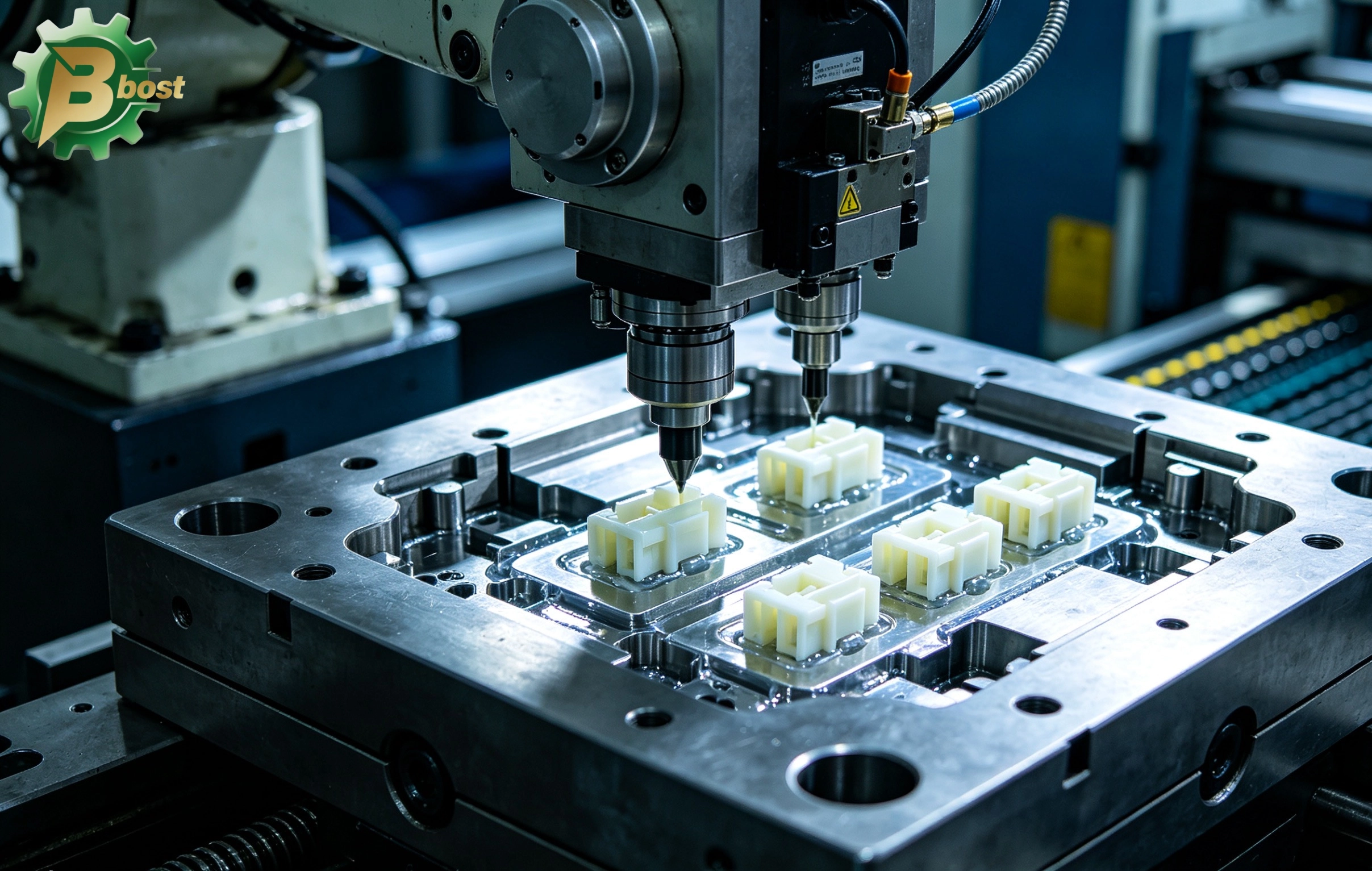
Manufacturing parts from Special Engineering Plastics is no easy feat. Due to their high melting points and high viscosity, they place stringent requirements on injection molding machines and mold designs.
Precise Mold Temperature Control
While conventional plastics might only require mold temperatures of 40-80°C, materials like PEEK often require over 160°C. If the mold temperature fluctuates by more than ±5°C, internal stresses can develop within the product, leading to cracking or dimensional deformation during later use.
Wear Resistance of Screws and Barrels
Special plastics are often reinforced with glass or carbon fibers to enhance performance. These fillers are highly abrasive in a high-temperature molten state. GZ-BOST utilizes alloy screws treated with special coatings to ensure that materials do not fail due to metal ion contamination during long production cycles—a factor critical for medical and semiconductor clients.
Precision Injection and Venting Design
Since the processing temperatures for special plastics are extremely high, the risk of material decomposition and gas generation increases. During the mold design phase, we use CAE mold flow analysis to accurately position venting slots, avoiding defects such as "burn marks" or "bubbles."
4. Why Choose GZ-BOST for Your Special Plastic Projects?
At GZ-BOST, we are more than just an OEM; we are your "technical partner." Handling Special Engineering Plastics requires a deep respect for material characteristics and ultimate control over process parameters.
We possess a comprehensive quality monitoring system. From the drying process before raw materials enter storage (special plastics are extremely sensitive to moisture and can degrade easily) to real-time pressure monitoring during injection, and post-production annealing to eliminate internal stress—every step is recorded for full-chain traceability.
5. Conclusion: From Material Science to Engineering Practice
Choosing the right Special Engineering Plastics is only the starting point of a successful project; high-quality injection molding processes are the bridge that transforms drawings into reliable products. Whether you are seeking lightweight metal replacements or reliable electrical insulation for extreme conditions, a professional injection molding partner can save you significant trial-and-error costs.
Looking for High-Quality Injection Molding Solutions?
If you are searching for a professional team capable of handling Special Engineering Plastics, or if you need material advice for specific application scenarios, visit our official website at https://www.gz-bost.com today to consult our expert team and receive a customized quote and technical support.
Recommended for you
The Peak Art of Custom Manufacturing According to Drawings: Comprehensive Guide to Precision Solutions for Custom Parts According to Drawing
Ending Mechanical Wear and Resonance: The Comprehensive Guide to Precision Customization and Mass Production of a Custom Rubber Pad
The Ultimate Armor for Smart Hardware: Advanced Customization and Precision Injection Molding Guide for a Custom Plastic Box
The Ultimate Weapon to Tame Vibration and Noise: Deep Dive into the Custom Process and Mass Production Logic of a Custom Rubber Bushing
Product Categories
FAQ
FAQs
How do I select the appropriate engineering plastic grade for my product?
Selection should be based on parameters such as load conditions (e.g., pressure/friction), temperature range, medium contact (e.g., oil/acid), and regulatory requirements (e.g., FDA/RoHS). Our engineers can provide free material selection consulting and sample testing.
What are the core advantages of Bost engineering plastics compared to ordinary plastics?
Bost engineering plastics feature ultra-high mechanical strength, high-temperature resistance (-50°C to 300°C), chemical corrosion resistance, and wear resistance. Compared to ordinary plastics, their service life is extended by 3 to 8 times, making them suitable for replacing metals in harsh environments.
What is the delivery lead time? Do you offer global logistics?
Standard products: 5–15 working days; custom modifications: 2–4 weeks. We support global air/sea freight and provide export customs clearance documents (including REACH/UL certifications).
Can Bost customize modified plastics with special properties?
Yes! We offer modification services such as reinforcement, flame retardancy, conductivity, wear resistance, and UV resistance, for example:
• Adding carbon fiber to enhance stiffness
• Reducing the coefficient of friction through PTFE modification
• Customizing food-grade or medical-grade certified materials
What is the minimum order quantity (MOQ)? Do you support small-batch trial production?
The MOQ for standard products is ≥100kg. We support small-batch trial production (as low as 20kg) and provide mold testing reports and performance data feedback.
You may also like
Custom Plastic Knobs Precision Injection Molded
More Details →
Custom Plastic Knobs Precision Injection Molded
Custom Injection Molded Parts from Drawings
More Details →
Custom Injection Molded Parts from Drawings
Underwater Camera Shell Custom Plastic Molding
More Details →
Underwater Camera Shell Custom Plastic Molding
Leave a Message
Have any questions or concerns about our products? Please leave us a message here, and our team will get back to you promptly.

24 hours quotes delivered
Submit CAD files, get quote in 24 hours

No MOQ required
From prototyping to high-volume

±0.02 mm Precision
Advanced CNC with full inspections

1,000+ tons in stock
26 materials ready to ship
© 2026 BOST. All Rights Reserved.