




 Scan QR Code
Send My Request
Mastering the "King of Plastics": An In-Depth Guide to the Core Technical Barriers and Processes of PEEK injection molding
2026-04-14
Discover Bost’s expert insights on PEEK injection molding in this comprehensive guide. Learn about core technical barriers and processes to ensure high-quality PEEK injection molded parts. Trust Bost as your reliable PEEK injection molding service and supplier for superior results.
- Why is PEEK injection molding the "Touchstone" of Specialty Manufacturing?
- In-Depth Analysis: The Three Core Technical Barriers of PEEK injection molding
- 1. Extreme Temperature Control Systems and Specialized Equipment Modification
- 2. The Life-or-Death "Invisible Killer": Crystallinity Control
- 3. Zero-Tolerance Mold Design and Runner Optimization
- Cutting-Edge Applications: How is PEEK injection molding Reshaping Modern Industry?
- Conclusion: Transforming High Trial-and-Error Costs into Robust Mass Production Advantages
In the current global industrial wave marching toward lightweighting, miniaturization, and extreme environmental tolerance, product design engineers are increasingly hitting the "ceiling" of material performance. When traditional commodity engineering plastics soften and collapse under high heat, and when metal components are phased out due to weight or electromagnetic interference, the eyes of the entire industry have turned to a super-material known as the "King of Plastics"—Polyetheretherketone (PEEK).
However, many R&D directors and purchasing managers have fallen into this hidden trap: they spend heavily on PEEK raw materials and hand them over to an ordinary injection molding factory for contract manufacturing. The result? The molded parts turn out dark in color, full of internal voids, or simply snap in half under the slightest pressure on the test bench. The cruel truth behind this is: knowing that PEEK is an excellent material is one thing, but truly mastering the PEEK injection molding process is a technical challenge of an entirely different dimension.
Today, drawing upon Bost Plastics' years of accumulated practical experience in the overseas B2B market, we will comprehensively deconstruct this top-of-the-pyramid manufacturing technology without reservation, helping you avoid costly detours in the development of your next-generation products.
Why is PEEK injection molding the "Touchstone" of Specialty Manufacturing?
PEEK is a semi-crystalline, high-temperature-resistant thermoplastic polymer. It is held as the gold standard because it not only operates continuously in 260°C high-temperature environments but also possesses incredibly formidable mechanical strength, outstanding chemical resistance, and extremely low outgassing. This makes it the perfect alternative to titanium alloys and stainless steel in aerospace, medical implants, and semiconductor manufacturing.
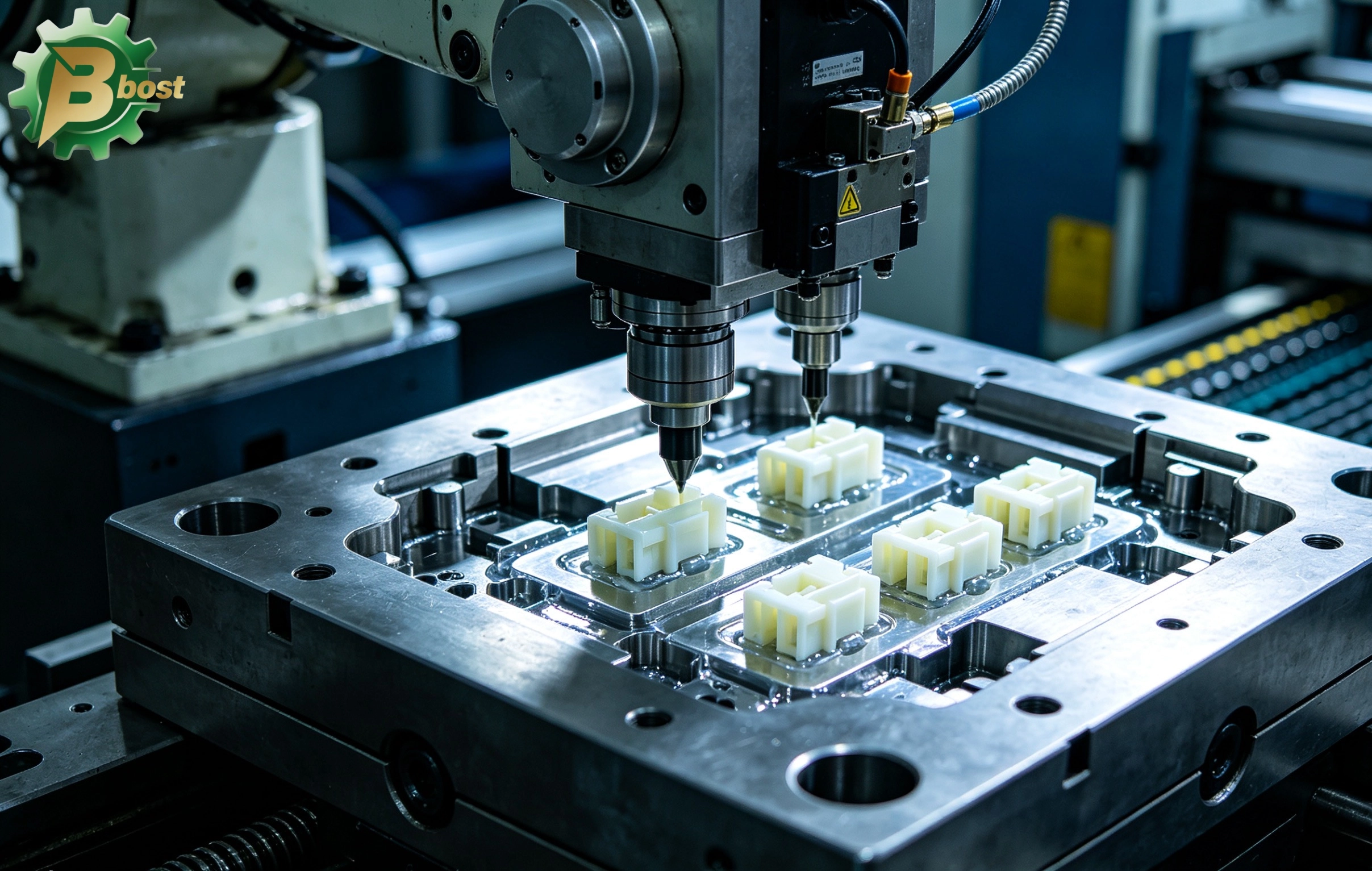
But the flip side of the coin is that its requirements for the injection molding process are nothing short of draconian. PEEK has a melting point of up to 343°C, which means conventional injection molding machines cannot even melt it thoroughly. PEEK injection molding is not just as simple as heating the material and shooting it into a mold; it is an extreme game of thermodynamics, fluid dynamics, and material phase transformation. Whether a factory possesses the hardcore capability of precision injection molding can often be tested with just one shot of a PEEK product.
In-Depth Analysis: The Three Core Technical Barriers of PEEK injection molding
To guarantee the dimensional stability and physical properties of PEEK parts during mass production, injection molding manufacturers must overcome the following three major mountains:
1. Extreme Temperature Control Systems and Specialized Equipment Modification
Ordinary injection molding machines can only heat up to around 300°C, whereas PEEK injection molding often requires barrel temperatures to reach 360°C to 400°C. Under such terrifyingly high temperatures, ordinary screws will severely carbonize or even seize up completely within just a few days.
Professional contract manufacturers must equip this process with specially nitrided or bimetallic clad wear-resistant and anti-corrosion screws. At the same time, the heater bands on the injection molding machine must be upgraded to ceramic heater bands to ensure absolute stability in heat output. Any temperature fluctuation exceeding 5°C will directly cause the PEEK melt to degrade, completely ruining the highly valuable raw material.
2. The Life-or-Death "Invisible Killer": Crystallinity Control
This is the exact spot where many inexperienced factories fail. PEEK is a semi-crystalline polymer, and the final mechanical properties and wear resistance of the product depend almost entirely on its crystallinity.
If the mold temperature is insufficient during the injection molding process, the resulting PEEK parts often appear as a translucent brown color (amorphous state). Parts in this state are extremely brittle and lack the dominance expected of the "King of Plastics." Truly successful PEEK injection molding demands that the mold temperature be strictly controlled between 160°C and 220°C. This requires the factory to be equipped with high-power, high-temperature hot oil mold temperature controllers (or even electrically heated mold systems). Only by cooling slowly within a continuously hot mold cavity can the PEEK molecular chains align fully to form a dense crystalline structure, ultimately presenting its signature opaque beige color.
3. Zero-Tolerance Mold Design and Runner Optimization
At high temperatures, the viscosity of the PEEK melt is extremely high, and its flowability is exceedingly poor—akin to squeezing toothpaste. This poses a massive challenge to early-stage mold design.
Before tooling begins, senior engineering teams must utilize high-end mold flow analysis software to repeatedly simulate gate locations and runner sizes. If the gate is too small, excessive shear friction will occur, causing the material to carbonize instantly. If the venting is poorly designed, it will cause a "diesel effect" during high-speed injection, leading to scorched and blackened product edges. Furthermore, because the shrinkage rate of PEEK during crystallization is notoriously difficult to control, the shrinkage compensation design of the mold must be accurate to the micron level; otherwise, it will be impossible to meet medical or aerospace-grade tolerance requirements.
Cutting-Edge Applications: How is PEEK injection molding Reshaping Modern Industry?
Having understood the difficulty of the process, let's look at what critical pain points this technology actually solves for various industries:
-
Medical Devices and Orthopedic Implants: PEEK possesses excellent biocompatibility, and its elastic modulus is very close to that of human bone, effectively avoiding the "stress shielding effect" caused by metal implants. Through ultra-high precision PEEK injection molding, we can customize surgical instrument handles and medical consumables that can withstand countless cycles of high-pressure steam sterilization (autoclaving) for our medical clients.
-
Aerospace and New Energy Vehicles: In the aerospace and EV sectors where "every gram counts," replacing metal with PEEK gears, seal rings, and thermal insulators can achieve weight reductions of up to 60%, while remaining completely immune to the corrosion of aviation kerosene and automotive antifreeze.
-
Semiconductor and Electronics Manufacturing: The chip manufacturing process is filled with strong acid and alkali environments. PEEK wafer carriers processed through specialized injection molding not only withstand harsh chemical cleaning but also will not leach impurities to contaminate the chips, unlike other materials.
Conclusion: Transforming High Trial-and-Error Costs into Robust Mass Production Advantages
In this era where the margin for error is increasingly low, PEEK injection molding is absolutely not a project where you can just find a random street-side workshop and "give it a try." The exorbitant price of raw materials dictates that every failed mold trial is burning a massive amount of funds. What you need is a strategic partner equipped with specialized machinery, a deep understanding of polymer material characteristics, and a spirit of scientific molding.
As experts deeply rooted in the B2B injection molding sector for many years, Bost Plastics has successfully delivered massive quantities of highly difficult specialty engineering plastic components for top-tier enterprises worldwide. We not only possess imported injection molding fleets specifically built for high-temperature materials, but also a senior engineering team capable of providing you with in-depth DFM (Design for Manufacturability) analysis.
Are you still having headaches trying to find a reliable mass-production solution for your PEEK project? Don't let technical barriers slow down your pace of seizing the market. Visit our official website right now: https://www.gz-bost.com, and submit your drawings and application scenario requirements. Our engineering experts will provide you with one-on-one technical evaluation and the most competitive quote within 24 hours, helping your hardcore product succeed on its very first mold trial!
Recommended for you
The Peak Art of Custom Manufacturing According to Drawings: Comprehensive Guide to Precision Solutions for Custom Parts According to Drawing
Ending Mechanical Wear and Resonance: The Comprehensive Guide to Precision Customization and Mass Production of a Custom Rubber Pad
The Ultimate Armor for Smart Hardware: Advanced Customization and Precision Injection Molding Guide for a Custom Plastic Box
The Ultimate Weapon to Tame Vibration and Noise: Deep Dive into the Custom Process and Mass Production Logic of a Custom Rubber Bushing
Product Categories
FAQ
FAQs
How do I select the appropriate engineering plastic grade for my product?
Selection should be based on parameters such as load conditions (e.g., pressure/friction), temperature range, medium contact (e.g., oil/acid), and regulatory requirements (e.g., FDA/RoHS). Our engineers can provide free material selection consulting and sample testing.
What is the delivery lead time? Do you offer global logistics?
Standard products: 5–15 working days; custom modifications: 2–4 weeks. We support global air/sea freight and provide export customs clearance documents (including REACH/UL certifications).
Can Bost customize modified plastics with special properties?
Yes! We offer modification services such as reinforcement, flame retardancy, conductivity, wear resistance, and UV resistance, for example:
• Adding carbon fiber to enhance stiffness
• Reducing the coefficient of friction through PTFE modification
• Customizing food-grade or medical-grade certified materials
What are the core advantages of Bost engineering plastics compared to ordinary plastics?
Bost engineering plastics feature ultra-high mechanical strength, high-temperature resistance (-50°C to 300°C), chemical corrosion resistance, and wear resistance. Compared to ordinary plastics, their service life is extended by 3 to 8 times, making them suitable for replacing metals in harsh environments.
What is the minimum order quantity (MOQ)? Do you support small-batch trial production?
The MOQ for standard products is ≥100kg. We support small-batch trial production (as low as 20kg) and provide mold testing reports and performance data feedback.
You may also like
Custom Plastic Knobs Precision Injection Molded
More Details →
Custom Plastic Knobs Precision Injection Molded
Custom Injection Molded Parts from Drawings
More Details →
Custom Injection Molded Parts from Drawings
Underwater Camera Shell Custom Plastic Molding
More Details →
Underwater Camera Shell Custom Plastic Molding
Leave a Message
Have any questions or concerns about our products? Please leave us a message here, and our team will get back to you promptly.

24 hours quotes delivered
Submit CAD files, get quote in 24 hours

No MOQ required
From prototyping to high-volume

±0.02 mm Precision
Advanced CNC with full inspections

1,000+ tons in stock
26 materials ready to ship
© 2026 BOST. All Rights Reserved.