




 Scan QR Code
Send My Request
The Ultimate Engineering Guide to Custom Rubber Plug Design and Procurement: From Blueprint to Mass Production
2026-06-10
Custom rubber plug supplier Bost breaks down the entire process of designing and procuring custom silicone rubber plugs, from blueprint creation to mass production. Learn precise engineering steps to ensure quality, cost-efficiency, and scalability in your rubber plug projects.
- 1. Front-End Design: DFM (Design for Manufacturability) Review for Your Custom Rubber Plug
- 1.1 The Rule of Uniform Wall Thickness
- 1.2 Incorporating Scientific Draft Angles
- 2. Process Selection: Precision Injection Molding vs. Traditional Compression Molding
- 3. "Mistake-Proofing" Engineering in Mold Design
- 3.1 Strategic Venting Layout
- 3.2 Wear Resistance of Inserts and Moving Slides
- 4. On-Site Quality Control (QC): Defining the Standard of Premium Quality
- 5. Guangzhou BOST: Your Trusted Global Manufacturing Partner
- 6. Launch Your Custom Project Today
In the B2B industrial manufacturing arena, the speed of product iteration and the reliability of the supply chain directly determine a company's survival. When engineers develop equipment requiring waterproofing, dustproofing, acoustic insulation, or high-pressure resistance, they often rely on a seemingly simple yet highly technical non-standard core component: the custom rubber plug.
Many procurement and R&D teams frequently fall into a common trap, assuming that rubber plugs are low-tech commodities that can be easily handled by any traditional compression molding shop. However, during mass production, they often run into "hidden bottlenecks" such as out-of-tolerance dimensions, assembly difficulties, poor environmental resistance, and flash-induced sealing failures.
As a premium manufacturer deeply rooted in high-standard global manufacturing, Guangzhou BOST brings over a decade of expertise in precision injection molding and fluid sealing to present this comprehensive engineering guide. This step-by-step roadmap is designed to help you avoid potential pitfalls at the early design phase and significantly compress your time-to-market.
1. Front-End Design: DFM (Design for Manufacturability) Review for Your Custom Rubber Plug
An exceptional product is not just designed; it is engineered for manufacturing. Before delivering the 3D files of your custom rubber plug to the toolmaker, a rigorous DFM assessment must be conducted to optimize the geometry.
1.1 The Rule of Uniform Wall Thickness
While keeping the functional sealing performance intact, the wall thickness of the rubber plug should remain as uniform as possible. If a part transitions abruptly from a very thick section (like a large head) to a thin cross-section (like a tail), the differential cooling and cross-linking speeds during the high-temperature vulcanization of the injection molding process will inevitably cause internal vacuum voids or surface sink marks.
-
The Golden Rule: Keep wall thickness variations within 25%. For exceptionally bulky sections, incorporate a cored-out geometry accompanied by supporting ribs.
1.2 Incorporating Scientific Draft Angles
Although rubber materials possess inherent elasticity that allows for a degree of "force-molding" or undercut stripping, incorporating a proper draft angle dramatically decreases ejection friction and prevents surface tearing.
-
External Features: A draft angle of $1^\circ \text{ to } 2^\circ$ is highly recommended.
-
Deep Core Cavities: If the plug features deep internal blind holes, increase the draft angle to $3^\circ \text{ to } 5^\circ$ to prevent the core pin from tearing the rubber or deforming the finished piece during ejection.
2. Process Selection: Precision Injection Molding vs. Traditional Compression Molding
The manufacturing method you select dictates not only your upfront tooling capital expenditures but also directly influences the component's dimensional tolerances and piece price. For a high-caliber custom rubber plug, two major processing paths dominate the industry:
| Comparative Dimension | Traditional Compression Molding | LSR/TPE Precision Injection Molding |
|---|---|---|
| Production Consistency | Highly dependent on manual compound placement, leading to part-to-part variations. | Fully automated closed-loop precision injection molding systems yield unparalleled consistency. |
| Parting Line & Flash Control | Flash is typically heavy (>0.2mm), requiring labor-intensive manual deflashing. | Advanced (mold design) limits parting line flash to under 0.05mm, or enables flashless molding. |
| Cycle Time Efficiency | Long vulcanization times, typically running 3 to 8 minutes per cycle. | Fast material delivery and cure speeds compress cycles down to 20–60 seconds. |
| Upfront Tooling Investment | Simple mold configurations keep initial tooling costs relatively low. | Complex runner systems, cold decks, and tight tolerances demand higher initial tooling investments. |
| Ideal Application Fit | Low-volume orders, relaxed tolerances (e.g., $\pm0.2\text{mm}$), and geometrically simple profiles. | High-volume campaigns (>10k pcs), ultra-tight tolerances, and intricate geometries. |
As illustrated by the data, if your project involves a high-frequency industrial standard part or critical automotive electronics components, leveraging a modern injection molding process is undeniably the more economical and quality-assured choice over the long run.
3. "Mistake-Proofing" Engineering in Mold Design
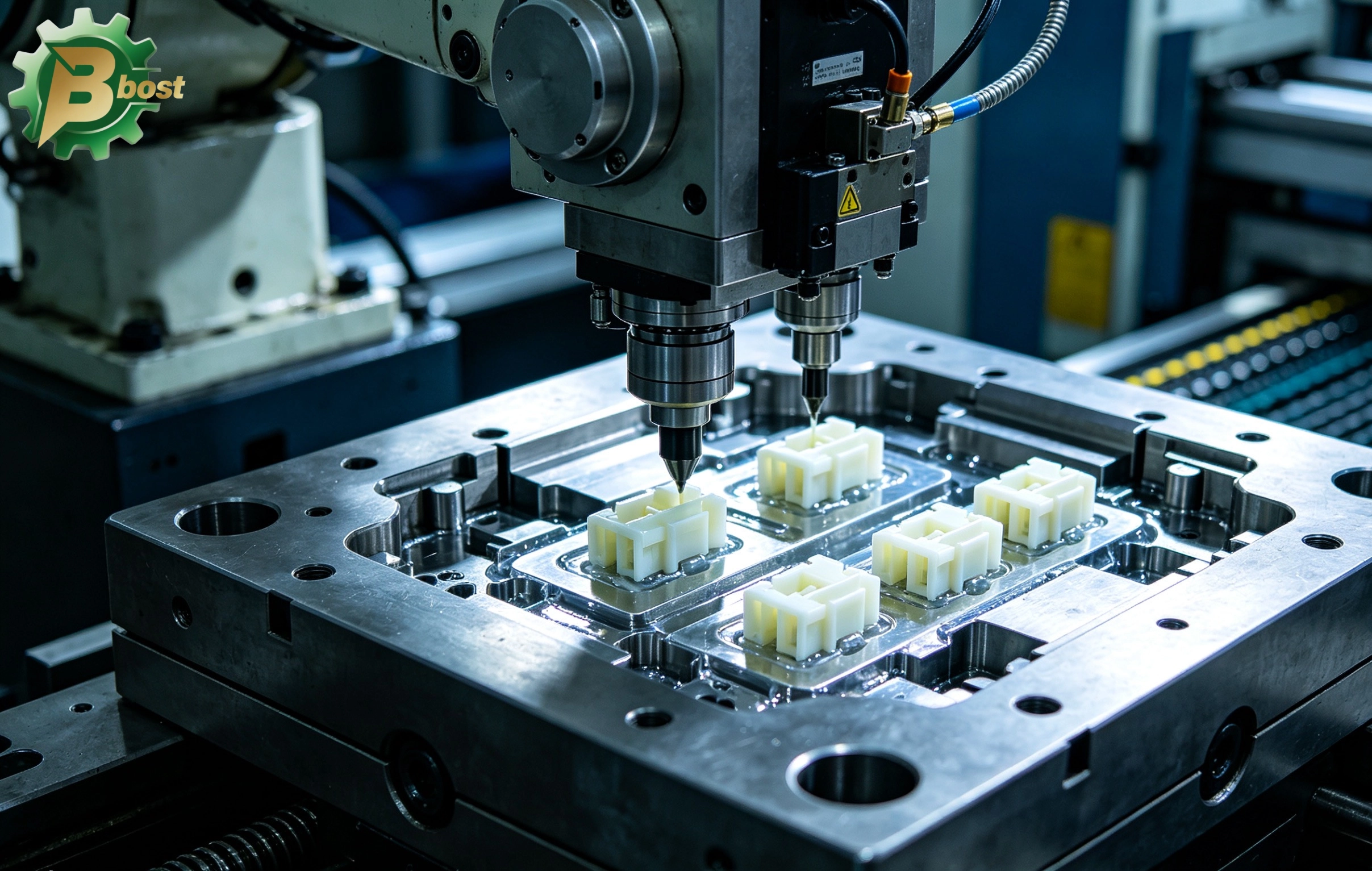
The mold is the matrix of manufacturing. Behind every high-performance custom rubber plug lies an meticulously engineered injection mold. During our development stage, we mandate two critical mistake-proofing engineering reviews:
3.1 Strategic Venting Layout
When the elastomeric compound is rapidly driven into a closed mold cavity under high velocity, trapped air and micro-gases generated by the compound can create localized high pressure, resulting in short shots or material burning. For miniature rubber plugs, we grind microscopic micro-vents on the mold parting lines measuring just 0.005mm to 0.01mm deep. This precise depth permits trapped air to escape freely while blocking the highly viscous rubber compound from entering, preventing flash.
3.2 Wear Resistance of Inserts and Moving Slides
When a custom rubber plug design features complex radial undercuts or side holes, the tooling must deploy forced-ejection mechanisms or mechanical side actions (sliders). Given that rubber injection molding temperatures regularly range from $160^\circ\text{C} \text{ to } 190^\circ\text{C}$, prolonged high-temperature, high-pressure reciprocal motion causes severe tooling wear. Consequently, all critical core inserts must be machined from premium imported tool steels (such as S136 or H13) and subjected to deep vacuum hardening to guarantee a tool life exceeding 500,000 cycles.
4. On-Site Quality Control (QC): Defining the Standard of Premium Quality
During the product validation and delivery phase, comprehensive quality inspection records (such as FAI or PPAP documentation) are mandatory. For industrial-grade rubber plugs, our inspection criteria focus heavily on the following quantitative engineering metrics:
-
Closed-Loop Dimensional Metrology: Utilizing automated Optical Measuring Machines (OMM), we perform non-contact measurements on critical sealing interference dimensions to ensure they fall squarely within blueprint tolerance ranges.
-
Compression Set Resistance: The customized plugs are compressed under specific thermal conditions for a set duration to measure their elasticity retention. This index directly predicts whether the plug will fail or degrade during years of field service.
-
Hardness Uniformity Testing: Shore A durometer checks are conducted across multiple areas of a single production batch. Hardness variance must be strictly maintained within $\pm5\text{A}$ to prevent assembly failures stemming from localized soft or hard spots.
5. Guangzhou BOST: Your Trusted Global Manufacturing Partner
Delivering a flawless custom rubber plug solution demands a synthesis of field engineering experience, material expertise, and agile execution. Guangzhou BOST is a comprehensive partner that understands both precision manufacturing and the distinct pain points of the global B2B industrial market.
We have instituted a standardized DFM response protocol: the moment you upload your product blueprints, our technical staff analyzes the geometry for manufacturing conflicts and provides optimization feedback. From complex tool engineering to automated precision injection molding operations, we supply turnkey custom sealing solutions to clients across a diverse range of global industries.
6. Launch Your Custom Project Today
Do not allow a minor sealing component to stall your entire product launch timeline. Whether your application demands extreme temperature-resistant fluorocarbon (Viton) plugs or high-purity medical-grade silicone components, Guangzhou BOST can engineer a tailored solution that aligns with your technical specifications and budgetary targets.
We invite you to visit our official website at https://www.gz-bost.com to submit your custom specifications and CAD files. Our senior application engineering team will deliver a comprehensive technical feasibility report and a highly competitive B2B commercial quote within 24 hours. Partner with BOST, and let our disciplined engineering protect your product quality for the long haul!
Recommended for you
The Peak Art of Custom Manufacturing According to Drawings: Comprehensive Guide to Precision Solutions for Custom Parts According to Drawing
Ending Mechanical Wear and Resonance: The Comprehensive Guide to Precision Customization and Mass Production of a Custom Rubber Pad
The Ultimate Armor for Smart Hardware: Advanced Customization and Precision Injection Molding Guide for a Custom Plastic Box
The Ultimate Weapon to Tame Vibration and Noise: Deep Dive into the Custom Process and Mass Production Logic of a Custom Rubber Bushing
Product Categories
FAQ
FAQs
How do I select the appropriate engineering plastic grade for my product?
Selection should be based on parameters such as load conditions (e.g., pressure/friction), temperature range, medium contact (e.g., oil/acid), and regulatory requirements (e.g., FDA/RoHS). Our engineers can provide free material selection consulting and sample testing.
Can Best customize modified plastics with special properties?
Yes! We offer modification services such as reinforcement, flame retardancy, conductivity, wear resistance, and UV resistance, for example:
• Adding carbon fiber to enhance stiffness
• Reducing the coefficient of friction through PTFE modification
• Customizing food-grade or medical-grade certified materials
What are the core advantages of Best engineering plastics compared to ordinary plastics?
Best engineering plastics feature ultra-high mechanical strength, high-temperature resistance (-50°C to 300°C), chemical corrosion resistance, and wear resistance. Compared to ordinary plastics, their service life is extended by 3 to 8 times, making them suitable for replacing metals in harsh environments.
What is the delivery lead time? Do you offer global logistics?
Standard products: 5–15 working days; custom modifications: 2–4 weeks. We support global air/sea freight and provide export customs clearance documents (including REACH/UL certifications).
What is the minimum order quantity (MOQ)? Do you support small-batch trial production?
The MOQ for standard products is ≥100kg. We support small-batch trial production (as low as 20kg) and provide mold testing reports and performance data feedback.
You may also like
Custom Plastic Knobs Precision Injection Molded
More Details →
Custom Plastic Knobs Precision Injection Molded
Custom Injection Molded Parts from Drawings
More Details →
Custom Injection Molded Parts from Drawings
Underwater Camera Shell Custom Plastic Molding
More Details →
Underwater Camera Shell Custom Plastic Molding
Leave a Message
Have any questions or concerns about our products? Please leave us a message here, and our team will get back to you promptly.

24 hours quotes delivered
Submit CAD files, get quote in 24 hours

No MOQ required
From prototyping to high-volume

±0.02 mm Precision
Advanced CNC with full inspections

1,000+ tons in stock
26 materials ready to ship
© 2026 BOST. All Rights Reserved.