




 Scan QR Code
Send My Request
High-Performance Plastics Guide: Key Success Factors and Technical Specs for PEEK Injection Molding
2026-04-08
Discover Bost’s expert guide on high-performance plastics, focusing on PEEK injection molding. Learn key success factors and technical specs to choose the best PEEK injection molding supplier for your needs. Optimize your projects with our trusted insights and industry-leading solutions.
In the world of high-performance engineering plastics, PEEK (Polyetheretherketone) is revered for its "metal-like" performance under extreme conditions. However, for manufacturing partners, the consistent production of parts meeting aerospace or medical standards via PEEK injection molding is an immensely challenging task. This guide provides a detailed technical reference to help optimize your production process and reduce scrap rates.
1. PEEK Material Properties and Preparation
Before initiating a PEEK injection molding project, it is vital to understand the material's basic physical attributes. PEEK has a continuous service temperature of up to 260°C and exhibits excellent wear and chemical resistance.
-
Drying Requirements: Even trace amounts of moisture can cause polymer degradation. We recommend drying in a desiccant dryer at 150°C for 3-4 hours, or 120°C overnight.
-
Melt Flow: PEEK has a high melt viscosity, which means that runners and gates must be designed with more consideration than for conventional PP or ABS.
2. Core Technical Parameters: Temperature Control
Temperature is the soul of PEEK injection molding. Incorrect temperature settings will not only affect dimensions but also destroy the material's crystallinity.
| Parameter | Recommended Range | Expert Tip |
| Rear Barrel Temp | 350°C - 360°C | Ensure uniform melting begins |
| Middle/Front Barrel Temp | 370°C - 390°C | Avoid exceeding 400°C to prevent degradation |
| Nozzle Temp | 375°C - 385°C | Prevent "cold slug" blockage |
| Mold Temp | 175°C - 200°C | CRITICAL! Determines crystallinity |
3. Machine Selection and Configuration
Not all injection molding machines are capable of handling PEEK injection molding. Due to the extreme processing temperatures, standard seals and heater bands will fail rapidly.
-
Heater Bands: Ceramic heater bands must be used, as they can stably maintain temperatures above 400°C.
-
Screw Design: A screw with an L/D ratio between 18:1 and 24:1 is recommended, with a compression ratio between 2:1 and 3:1 to minimize excessive shear on the high-viscosity melt.
-
Injection Pressure: Since PEEK solidifies quickly and is highly viscous, high injection pressures (150-200 MPa) are typically required.
4. Common Defect Analysis and Solutions
Operators often encounter the following challenges during PEEK injection molding:
-
Discoloration (Charring): Usually caused by local overheating and material degradation. Check for dead spots in the nozzle and ensure the screw speed is not too high.
-
Warpage: This is caused by internal stress release due to uneven mold cooling. We suggest increasing oil temperature circulation channels within the mold to ensure uniform heating.
-
Low Crystallinity: If the part appears black and shiny rather than grayish-brown, the mold temperature is too low. You must force a higher mold temperature to allow molecular chains sufficient time to align.
5. Why Choose GZ-BOST for PEEK Processing?
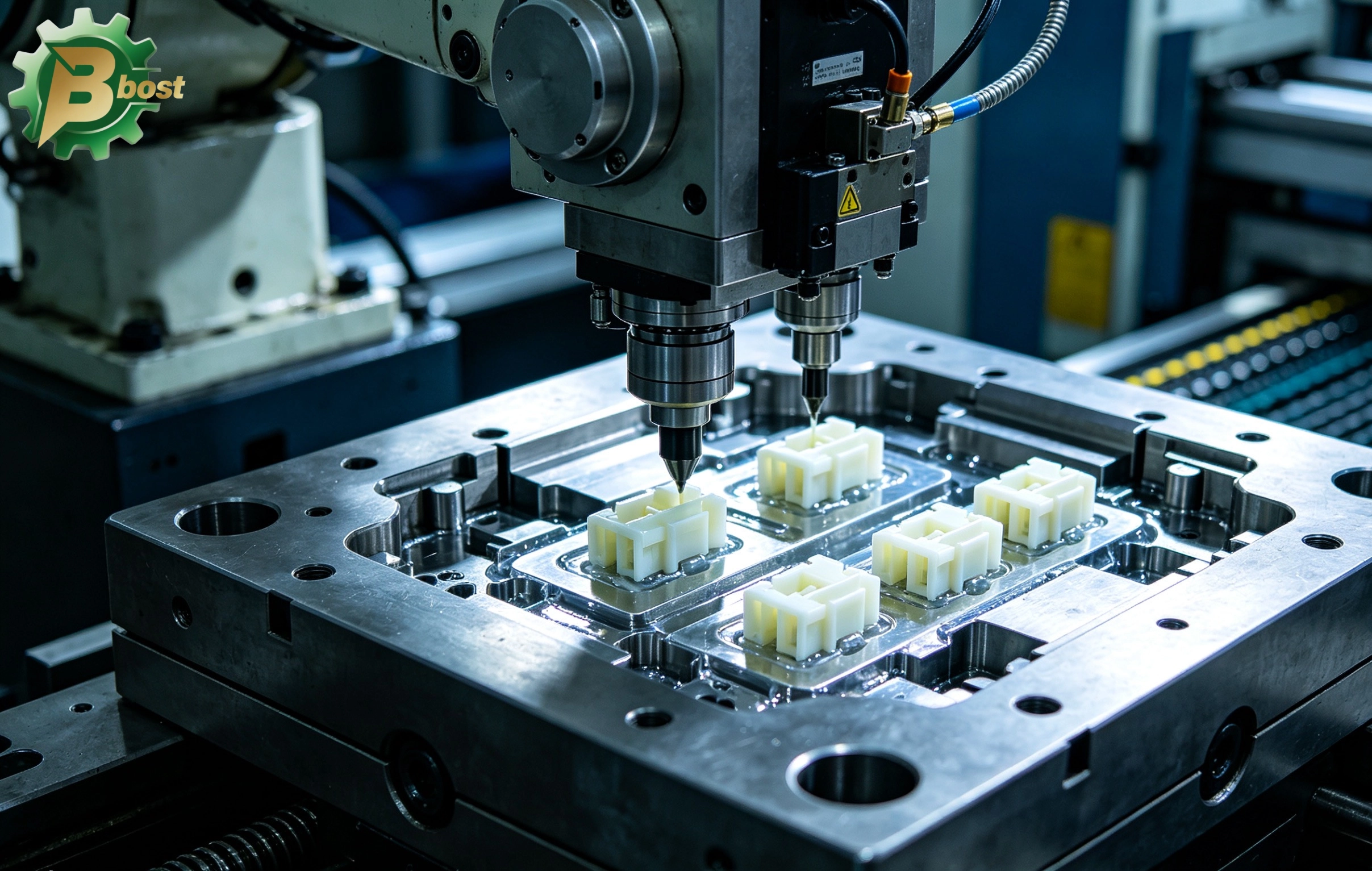
At GZ-BOST, we understand that precision injection molding is not just about machines—it is about respecting the nature of the material. We operate specialized injection molding machines equipped with high-power heating systems, capable of handling PEEK injection molding projects with ultra-thin walls or highly complex geometries.
We offer more than just processing; we provide full-spectrum consultation from material selection and mold flow analysis to post-treatment annealing.
Get Your Customized Solution Today:
If you are looking for PEEK injection molding experts who can handle challenging projects, visit the GZ-BOST Official Website to submit your drawings. Our engineering team will provide a detailed quote and manufacturability analysis within 24 hours.
Recommended for you
The Peak Art of Custom Manufacturing According to Drawings: Comprehensive Guide to Precision Solutions for Custom Parts According to Drawing
Ending Mechanical Wear and Resonance: The Comprehensive Guide to Precision Customization and Mass Production of a Custom Rubber Pad
The Ultimate Armor for Smart Hardware: Advanced Customization and Precision Injection Molding Guide for a Custom Plastic Box
The Ultimate Weapon to Tame Vibration and Noise: Deep Dive into the Custom Process and Mass Production Logic of a Custom Rubber Bushing
Product Categories
FAQ
FAQs
Can Bost customize modified plastics with special properties?
Yes! We offer modification services such as reinforcement, flame retardancy, conductivity, wear resistance, and UV resistance, for example:
• Adding carbon fiber to enhance stiffness
• Reducing the coefficient of friction through PTFE modification
• Customizing food-grade or medical-grade certified materials
What are the core advantages of Bost engineering plastics compared to ordinary plastics?
Bost engineering plastics feature ultra-high mechanical strength, high-temperature resistance (-50°C to 300°C), chemical corrosion resistance, and wear resistance. Compared to ordinary plastics, their service life is extended by 3 to 8 times, making them suitable for replacing metals in harsh environments.
What is the delivery lead time? Do you offer global logistics?
Standard products: 5–15 working days; custom modifications: 2–4 weeks. We support global air/sea freight and provide export customs clearance documents (including REACH/UL certifications).
How do I select the appropriate engineering plastic grade for my product?
Selection should be based on parameters such as load conditions (e.g., pressure/friction), temperature range, medium contact (e.g., oil/acid), and regulatory requirements (e.g., FDA/RoHS). Our engineers can provide free material selection consulting and sample testing.
What is the minimum order quantity (MOQ)? Do you support small-batch trial production?
The MOQ for standard products is ≥100kg. We support small-batch trial production (as low as 20kg) and provide mold testing reports and performance data feedback.
You may also like
Custom Plastic Knobs Precision Injection Molded
More Details →
Custom Plastic Knobs Precision Injection Molded
Custom Injection Molded Parts from Drawings
More Details →
Custom Injection Molded Parts from Drawings
Underwater Camera Shell Custom Plastic Molding
More Details →
Underwater Camera Shell Custom Plastic Molding
Leave a Message
Have any questions or concerns about our products? Please leave us a message here, and our team will get back to you promptly.

24 hours quotes delivered
Submit CAD files, get quote in 24 hours

No MOQ required
From prototyping to high-volume

±0.02 mm Precision
Advanced CNC with full inspections

1,000+ tons in stock
26 materials ready to ship
© 2026 BOST. All Rights Reserved.